By Andre Thomas, NASM CPT | The F.I.T.T. PIT | June 27, 2026
Resistance Bands for Women Over 40: Stop Treating Them Like a Cop-Out
You think the band is for grandmas in a chair. You're wrong. Resistance bands for women over 40 are one of the most slept-on tools in the gym, and most of you skip them because they don't look hard. The band doesn't care what you think. It pulls back, and your muscle has to answer.
What a band actually does to your muscle
Your muscle can't tell where the resistance comes from. It feels tension and it responds to tension. Mechanical tension is the main driver of muscle growth, and a band loaded near the end of its stretch puts real tension on the tissue.
And here's the part that bruises egos. Lighter loads taken close to failure build muscle about as well as heavy loads. The research comparing low-load and high-load training found similar muscle gains when both sets were pushed hard. The weight matters less than how close you take the set to the edge.
That matters more after 40. You lose 3 to 5 percent of your muscle every decade once you stop training it. That muscle is your metabolism, your strength, and your independence later in life. Read the full breakdown in my piece on muscle loss after 40. The band is one way to fight back, and it's a way that fits in a drawer.
Why bands go easy on 40-plus joints
A band gives you the least resistance at the start of the movement and the most at the end. Your joint is at its weakest at the bottom of a press or a squat. That's exactly where the band is loosest.
So your shoulder, knee, or elbow takes less stress in the position that usually barks at you. For a body that has lived, that's a real edge. Strength training keeps muscle, bone, and joints working, and bands let you do it without grinding a cranky joint into the floor.
If something already hurts, you train around it, not through it. I wrote a whole piece on exercising with joint pain over 40. Bands slide right into that plan.

Where bands beat dumbbells, and where they lose
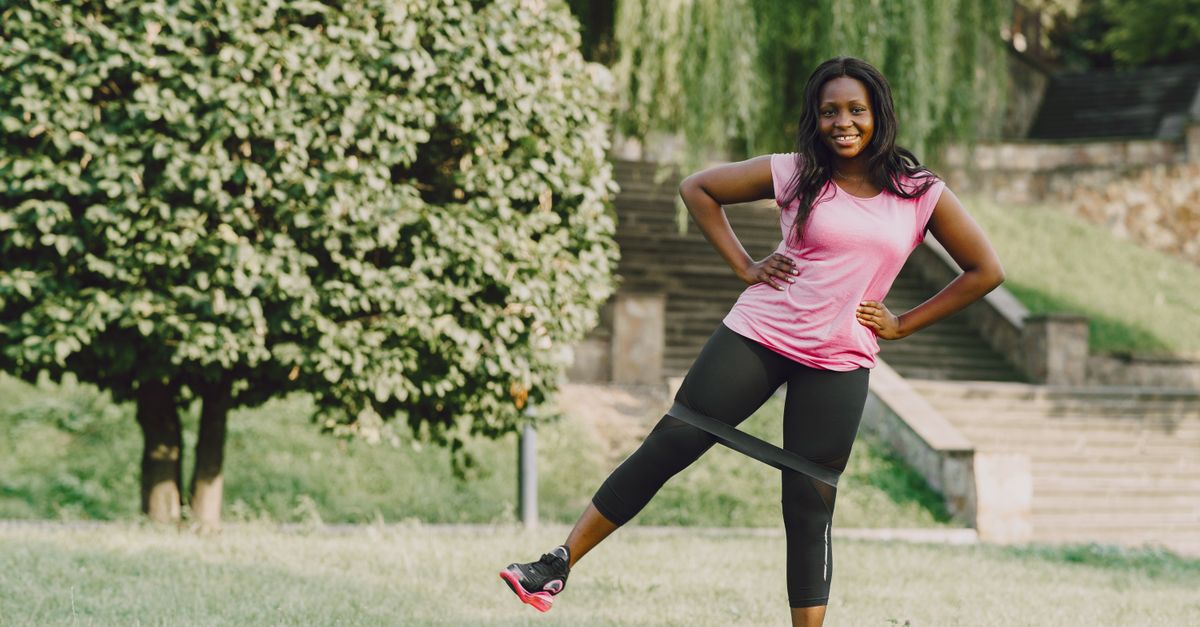
Bands win on things iron can't touch. They travel in a gym bag. They keep tension on the muscle through the whole range, top to bottom. And they load sideways and twisting moves, like lateral walks and pull-aparts, that dumbbells handle badly.
But I'm not going to lie to you. Bands lose when it's time to go heavy. You can't band-load a squat the way a barbell can, and your bones need that heavier load to stay dense. Bone responds to heavier resistance training, so bands work best next to real weight, not in place of it.
So use both. Bands for tension, control, and the small muscles that hold you together. Iron for the big heavy lifts. A smart week runs bands on your off days or as a finisher and saves the barbell for your main sessions. If you want the full case for loading up, read strength training for women over 40 and my take on free weights and machines.
The band moves that earn their place
Skip the random arm waving you see online. These are the moves that pay you back.
- Banded glute bridge or hip thrust. Wakes up the muscles a desk chair put to sleep.
- Lateral band walks. Hits the side glute that keeps your knees tracking straight.
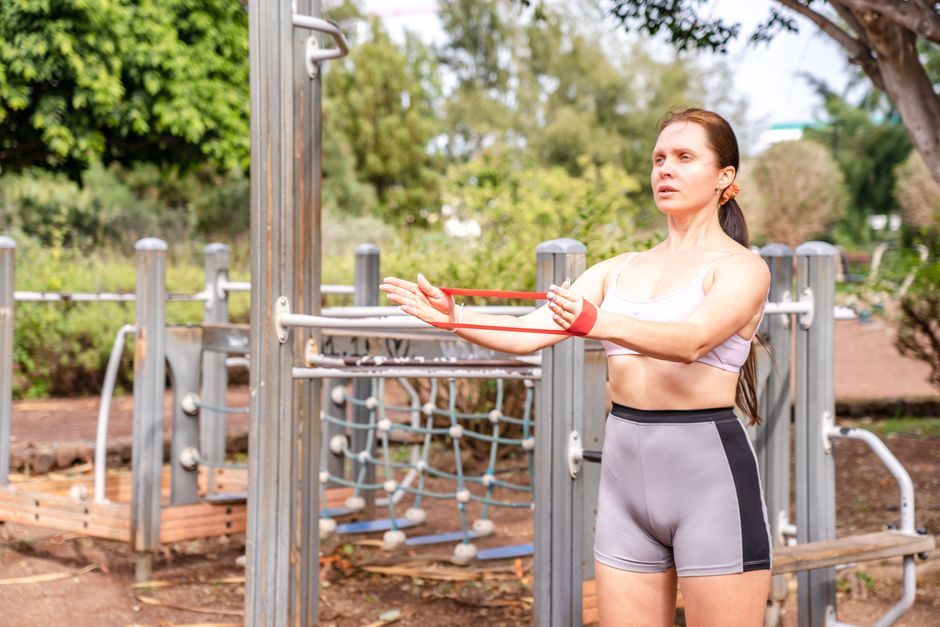
- Band pull-aparts. The fix for rounded shoulders and a folded-over upper back.
- Banded row. Builds the back without loading your lower spine.
- Banded press. Pressing strength on a shoulder-friendly path.
- Pallof press. Anti-rotation core work that actually protects your spine.
Six moves. Two or three sets each. You've got a full-body session, and you never touched a dumbbell.
How to actually get stronger with a band
Here's where people quit. They think you can't progress with a band because you can't add a plate. You can. You just change the inputs.
Shorten the band so it pulls tighter. Step up to a thicker band. Slow the lowering down to a four-count. Add reps. Pause at the hardest point and hold the tension. Each of those raises the demand on the muscle, and raising the demand over time is the whole game. That's progressive overload, band or barbell. Same rule, different tool.
And write it down. Same as you would with weights. If you got 12 clean reps on the medium band this week, beat it next week. Bands hide your progress because there's no number stamped on the side, so the job of tracking falls on you. No log, no proof, no progress. That's how most band routines stall out and the woman holding it decides bands don't work.

The mistake that makes bands useless
Most people let the band snap them back. They fight it on the way out, then go limp on the way in. That throwaway return is a wasted rep, and it's why some women swear bands do nothing.
The lowering phase is where a big chunk of your strength gets built. Controlled eccentric work drives growth, so fight the band back to the start on every single rep. And stop using the toy band. If the last three reps aren't ugly, the tension is too light and you're wasting your time.
Frequently asked questions
Can resistance bands really build muscle after 40?
Yes. As long as you take the set close to failure, lighter resistance builds muscle on par with heavy weight. The band counts as resistance. Your muscle doesn't know the difference between rubber and steel.
Are resistance bands enough on their own?
For general strength, muscle tone, and staying mobile, a band program can carry you a long way. For maximum strength and bone density, you still want heavier loading. Use bands as a big part of the plan, not the whole plan.
What bands should I buy?
Get a set of loop bands in light, medium, and heavy, plus one longer tube band with handles. That covers glutes, back, shoulders, and presses. You don't need the fancy kit with the door anchor and the carry case you'll never open.
Will bands help with arm jiggle?
Bands build the muscle under the arm. But the softness on top is body fat, and you lose that in the kitchen, not with a band. Build the muscle, fix the food, and the arm changes. There is no spot-reduction trick, no matter who is selling it.
Are bands safe for bad knees or shoulders?
Usually, yes, because the load is lightest right where the joint is weakest. Start light, keep it pain-free, and train around the sore spot. Resistance training is recommended for adults of all ages, and bands are one of the gentler ways in.
How often should I use bands?
Two to three days a week is plenty to build strength and hold onto muscle. Leave a day between hard sessions so the tissue has time to recover and come back stronger.
Want a band program that actually progresses?
Virtual coaching is delivered through the F.I.T.T. PIT app. You get a real program from a real coach, anywhere. thefittpit.com/virtual-coaching


