
By Andre Thomas, NASM CPT | The F.I.T.T. PIT | June 26, 2026
Squats for Women Over 40: No, They're Not Bad for Your Knees
Somebody told you squats are bad for your knees. Maybe a doctor. Maybe a friend who heard it from a friend. They were wrong. Squats for women over 40 are one of the smartest things you can do for your knees, your bones, and your odds of staying off the floor for good. You bend your knees and hips, you sit down, you stand back up. Your body was built to do this. The trouble starts when you stop.
The knee myth that's keeping you out of a squat
Let me kill this one fast. Squats do not grind your knees into dust.
Your knee cartilage is not a brake pad that wears down with use. It is living tissue, and it needs regular loading to stay healthy. Force is food for a joint. Sit on the couch for a decade and the joint gets weaker, not safer. Move it under load and it gets stronger.
Physical therapists know this. That is why they put squats into rehab programs for cranky knees instead of pulling them out. The squat builds the muscle around the joint, and that muscle is what protects it.
Pain is different from damage. If a deep squat hurts, you scale the depth, fix the setup, and load it right. You do not quit squatting for the rest of your life over a rumor.
Why squats matter more after 40, not less
Here is the clock you are racing.
Starting in your 40s, you lose 3 to 5 percent of your muscle mass per decade if you do nothing to stop it. Most of that comes off your lower body, the biggest muscles you own. Lose those and everyday life gets harder one notch at a time. Stairs. Groceries. Getting off a low couch without a hand.
This is not a scare tactic. It is a measurable marker. Researchers found that how well an older adult can rise from a chair predicts disability, falls, and even survival. A squat is a loaded chair stand. Train it now and you train the exact movement that keeps you independent later.
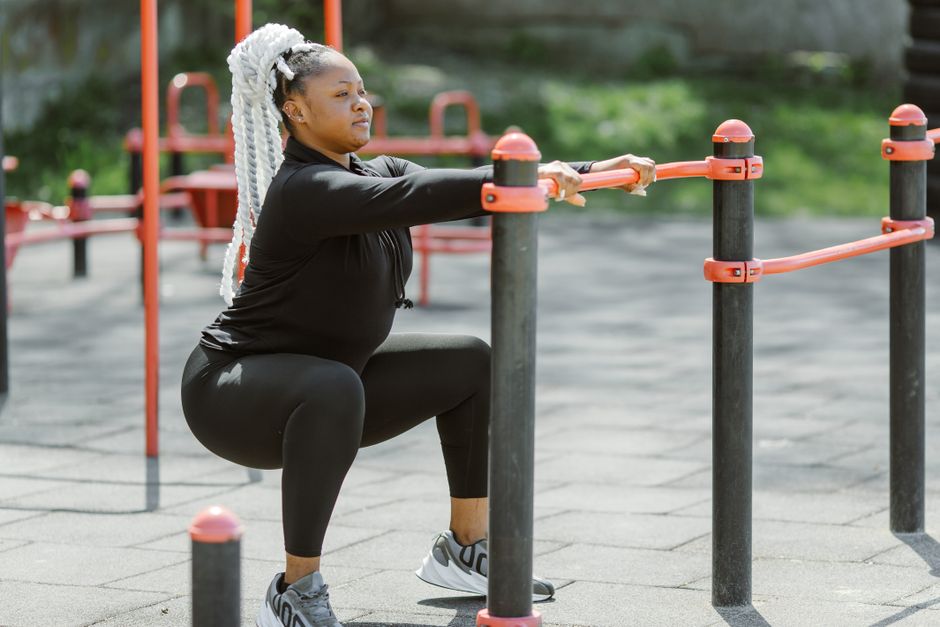
What a squat actually trains (it is not just legs)
People think the squat is a leg move. It is a whole-body move pretending to be a leg move.
One rep fires your hips, knees, ankles, quads, glutes, hamstrings, and calves all at once. Your core braces to keep your spine stacked. Your glutes do the heavy lifting out of the bottom. That is a lot of return on one exercise.
And it carries over to everything. Pick up a toddler, that is a squat. Get up off the garden bed, squat. Lower into a beach chair without crashing, squat. You are not training for a gym. You are training for your actual life.
Squats and your bones: the part nobody mentions
Your muscles are not the only thing that fades. Your bones go too, fast, especially around menopause.
Loaded squats fight back. Resistance training improves bone density at the spine and hip, the two places a fracture wrecks your life. Put a bar on your back and stand it up, and you send a signal down through your skeleton that says keep this bone, we still need it.
That is why we treat squats as bone insurance, not just a leg-day staple. You cannot supplement your way to strong bones. You have to load them.

Squats for women over 40: where to actually start
You do not start with a heavy barbell. You earn it. Here is the ladder we use.
- Box squat. Sit back to a bench or chair, tap, stand. This teaches the pattern and kills the fear of falling.
- Bodyweight squat. Same movement, no box. Go as low as you can control with a flat heel.
- Goblet squat. Hold a dumbbell at your chest. The weight in front helps you sit deeper and stay upright.
- Barbell squat. Once your pattern is clean and your goblet squat is strong, you graduate to the bar.
Most women over 40 can run this whole ladder in a few weeks with a coach watching. The deadlift and the squat together cover most of what your lower body needs.
How to squat without wrecking anything
Form is not complicated. It is just specific.
Stand with your feet about shoulder width, toes turned out a touch. Brace your middle like someone is about to poke you. Sit back and down, not straight down. Drive your knees out, not in. Stand up by pushing the floor away.
And yes, your knees can travel past your toes. That is normal human movement, not a crime. Ask anyone who has ever picked something up off the ground. The old cue to keep your knees behind your toes makes the lift worse, not safer. We coach real strength through a real range of motion.

Frequently asked questions
Are squats for women over 40 safe if I have knee pain?
Usually yes, with the right setup. Knee pain often means weak muscles around the joint, and squats build those muscles. Start with a box squat to a comfortable height and only go as low as feels solid. If one depth hurts, stay above it and load what does not. A coach earns their pay right here.
How low do I need to squat?
As low as you can control with your heels down and your back stacked. Deeper is better for strength and mobility, but only if you own the position. A clean squat to parallel beats a sloppy deep one every time.
Will squats make my legs bulky?
No. Women do not carry the hormone levels to balloon up from squatting. What you build is firm, strong, capable legs and a backside that does its job. Real bulk takes years of deliberate eating and training that most people never come close to.
How often should I squat?
Two to three times a week is plenty for most women over 40. That fits inside a normal strength program with room to recover. You do not need to squat every day. You need to squat well and add a little load over time.
Do I need a barbell to get results?
No. A box, your bodyweight, and a single dumbbell take a beginner a long way. The barbell is where you go when those stop being hard, not where you begin.
Should I squat if I have osteoporosis or osteopenia?
Often yes, and it may help, but get cleared by your doctor first and train with a coach. Loaded movement is one of the few things shown to support bone, but the dose and the form have to fit you. This is not a solo project off a phone screen.
Stop avoiding the one move that keeps you strong
Squats are not the dangerous lift. The dangerous choice is spending your 40s and 50s avoiding them, then wondering at 70 why standing up has become a project.
We coach the squat the right way. Scaled to where you are, loaded as you grow, watched by a person who knows what good looks like.
StrengthCamp is heavy work for bodies that have lived. First class is free. thefittpit.com


