
By Andre Thomas, NASM CPT | The F.I.T.T. PIT | June 8, 2026
Hydration and Exercise: How Much Water Do You Actually Need?
You walk into class with a gallon jug like you are auditioning for a supplement ad. Or you show up with nothing and wonder why you fell apart at minute 40. Both of you are guessing. Let me give you the real answer on how much water to drink when exercising, because the body you are training past 40 does not forgive dehydration the way it did at 25.
What dehydration actually does to your workout
Water is not a nice-to-have. Your muscles are about 75 percent water. Your blood needs volume to carry oxygen to working tissue. Drop that volume and everything slows down.
Research is blunt here. Losing just 2 percent of your body weight in fluid measurably drops performance. That is one pound of sweat on a 150-pound woman. One pound. You feel it as heavy legs, a higher heart rate, and a workout that feels twice as hard for half the output.
And it is not only the muscles. Even mild dehydration in women impairs mood, focus, and energy. So the brain fog you blame on a bad night might just be a dry tank.
How much water to drink when exercising (the real numbers)
Here is what actually works. Stop counting in cute eight-glass rules and start training around the clock.
Before class, drink 16 to 20 ounces about two hours out. That gives your body time to use it and pee out the rest before you start. Then sip 8 ounces 15 minutes before you walk in.
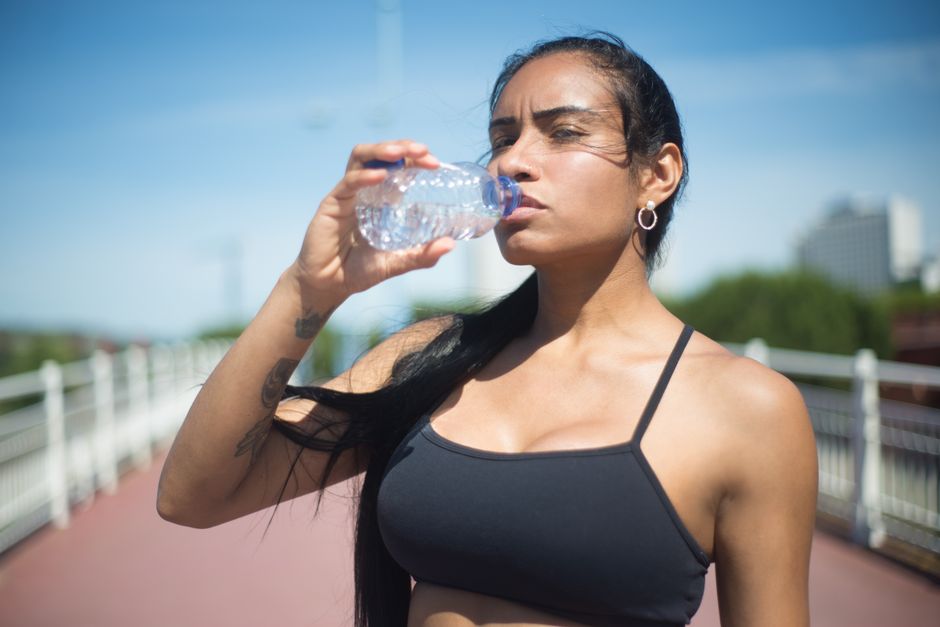
During a 60-minute session, aim for 7 to 10 ounces every 20 minutes. That is a few real swallows, not one panicked chug at the end. The American College of Sports Medicine backs this steady-sip approach over drowning yourself after the fact.
After, replace what you lost. Weigh yourself before and after a hard session one time. Every pound gone is about 16 to 24 ounces of water to drink back over the next few hours. Do that once and you will know your own sweat rate forever.

Why thirst is a terrible signal after 40
You were taught to drink when you feel thirsty. That advice gets worse every year you age.
As you get older, your thirst response gets blunted and lags behind real fluid loss. By the time you feel thirsty mid-workout, you are already down a percent or two. The signal shows up late and quiet.
So you cannot wait for thirst to tell you what to do. You drink on a schedule. You drink before you are dry. That is the whole shift.
Plain water or electrolytes?
For most classes under an hour, plain water gets the job done. You are not running a marathon. You are doing 60 minutes of coached work and going home to lunch.
But sweat is not just water. It carries sodium, potassium, and other electrolytes your nerves and muscles need to fire. Sweat hard for over an hour, train in summer heat, or notice white salt rings on your shirt, and you want some electrolytes back.
You do not need a neon sports drink loaded with sugar. A pinch of salt and a squeeze of citrus in your water does plenty. So does eating real food after. A banana and some salted nuts beat most powders on the shelf.
Can you drink too much water?
Yes. And it is more dangerous than most people think.
Chug far more than you sweat and you can dilute the sodium in your blood, a condition called hyponatremia. It causes nausea, headache, confusion, and in rare cases something far worse. The gallon-jug crowd is not safer. They are just wetter.
The fix is the same as the rest of this. Match your intake to your sweat. Sip steady. Do not force a gallon because the internet told you to.

What summer heat does to the math
A June class in Boston is not a January class. When the room is warm and the humidity climbs, your sweat rate jumps and so does your fluid loss.
Hot weather can push your sweat output to a quart or more per hour of hard work. That is the day you add electrolytes and bump your before-and-after numbers up. Heat also raises your risk of cramps and that wrung-out feeling, both of which trace back to fluid and sodium you never replaced.
So treat the calendar as part of your plan. Drink more on the hot days, not the same as always.
The simplest hydration test you own
Forget apps. Look in the toilet.
Pale yellow, like lemonade, means you are hydrated. Dark, like apple juice, means drink up. Clear all day long means you are probably overdoing it. Your urine color tracks your hydration closely and it costs nothing to check.
Run this check in the morning and once in the afternoon. It tells you more than any number on a bottle.
How this ties into fat loss and recovery
Dehydration does not just wreck one workout. It stacks.
When you train dehydrated, you lift less, your heart works harder, and you cut the session short. Less work means less stimulus for the muscle you are trying to build and keep. And water plays a direct role in how you recover between sessions, which is why we hammer on recovery as hard as the training itself.
Stay hydrated and you train harder, recover faster, and show up for the next class instead of nursing a headache on the couch. That consistency is what actually changes your body, the same way it does in our cardio work.
Frequently asked questions
How much water should I drink on a day I work out?
Start with roughly half your body weight in ounces as a baseline, then add the fluid you sweat out during your session on top. A 160-pound woman lands near 80 ounces baseline plus another 20 to 30 ounces around a hard class.
Should I drink water during my workout or just before and after?
All three. Drink 16 to 20 ounces a couple hours before, sip 7 to 10 ounces every 20 minutes during, and replace what you lost after. Sipping during keeps your performance steady instead of letting it crash mid-session.
Do I need a sports drink for a regular gym class?
Usually no. Plain water covers a session under an hour. Save the electrolytes for long, sweaty, or hot workouts, and skip the sugar bombs. A pinch of salt and some citrus does the same job.
Does coffee or tea count toward my water?
Mostly yes. The mild diuretic effect of normal coffee does not cancel out the fluid it carries. Your morning coffee still puts you ahead, not behind.
Why am I more dehydrated than I used to be?
Age. Your thirst signal weakens and your body holds less water as you get older. That is why you drink on a schedule now instead of waiting to feel thirsty.
What are the first signs I am dehydrated during exercise?
Heavy legs, a heart rate that climbs faster than usual, dizziness, and a workout that suddenly feels too hard. Dark urine before class is an early warning you started the day behind.
Train hydrated. Show up Saturday.
You can read about water all day. The change happens when you show up and do the work with a body that is actually fueled to perform. BootCamp is 60 minutes of coached conditioning. First class is free, no card required. thefittpit.com


