
By Andre Thomas, NASM CPT | The F.I.T.T. PIT | July 7, 2026
Plantar Fasciitis Exercises for Women Over 40: Your Feet Are Weak, Not Broken
You swing your legs out of bed, put one foot down, and a hot nail drives through your heel. That first-step pain is the calling card of plantar fasciitis. And if you are a woman over 40, you are standing right in the target zone. Here is the thing nobody sells you a gadget for: the right plantar fasciitis exercises for women over 40 actually fix it. Not gel inserts. Not rest. Load.
Let me kill the myth fast. Your foot is not broken. It is weak and stiff, and it has been for years.
What plantar fasciitis actually is (and why your heel screams every morning)
The plantar fascia is a thick band of tissue that runs along the bottom of your foot, from your heel to your toes. It works like a spring every time you stand, walk, or train. Overload it past what it can handle and the tissue develops small areas of irritation and breakdown. That is your pain.
Here is the part that fools people. It hurts worst in the morning because the tissue tightens up overnight, and that first step yanks on it cold. Walk around for ten minutes and it eases off. That does not mean it healed. It means you warmed up a problem you still have.
And it is everywhere. Somewhere around one in ten people get plantar fasciitis at some point, and it hits hardest between 40 and 60. You are not cursed. You are normal. And normal is fixable.
Why women over 40 get plantar fasciitis more
Three things stack up against you at this age. None of them are your fault. All of them are your job to fix now.
First, your tissue changed. As estrogen drops through perimenopause and menopause, collagen and connective tissue lose some of their strength and stretch. The plantar fascia is mostly collagen. Less springy tissue frays easier under the same load.
Second, you got weaker without noticing. Your calves, your feet, and the small muscles that hold up your arch lose strength every year you do not train them. A weak foot dumps all the work onto the fascia. The fascia was never meant to be the muscle. It just got promoted because nothing else showed up.
Third, life. More hours on your feet, more weight than you carried at 25, cheap shoes, and years of walking on your fascia instead of your muscles. Higher body weight and long hours standing are two of the biggest risk factors. Add it up and the heel pays the bill.

Why resting it is keeping you hurt
This is the part the waiting-room pamphlet leaves out. Rest feels smart. It is not.
Sit still and the pain quiets down. Then you take one long walk or one class and it flares worse than before. Why? Because the tissue got weaker while you rested. So now it handles even less than it did. You are not healing. You are shrinking how much life your foot can take before it complains.
The real fix is the opposite of what feels safe. You load the foot on purpose, slow and heavy, so the tissue rebuilds thicker and stronger. In one well-known trial, people who did slow, heavy calf raises with a towel under the toes beat plain stretching at the three-month mark. Read that again. Heavy beat gentle.
The plantar fasciitis exercises that actually work
Here is the work. Do it most days. It is boring and it is effective, which is true of almost everything that works.
1. Loaded heel raises with a towel under your toes. Roll a hand towel and set it under your toes so they point up. Stand on the floor or the edge of a step. Rise up on a slow three count, hold at the top, then lower even slower on a three count. This is the money move from the research. Start on two feet, build to one, then start holding a dumbbell. Three sets, and work toward heavy.
2. Toe scrunches and towel drags. Sit down, lay a towel flat on the floor, and drag it toward you using only your toes. Then push it back out. This wakes up the tiny foot muscles that have been asleep for a decade.
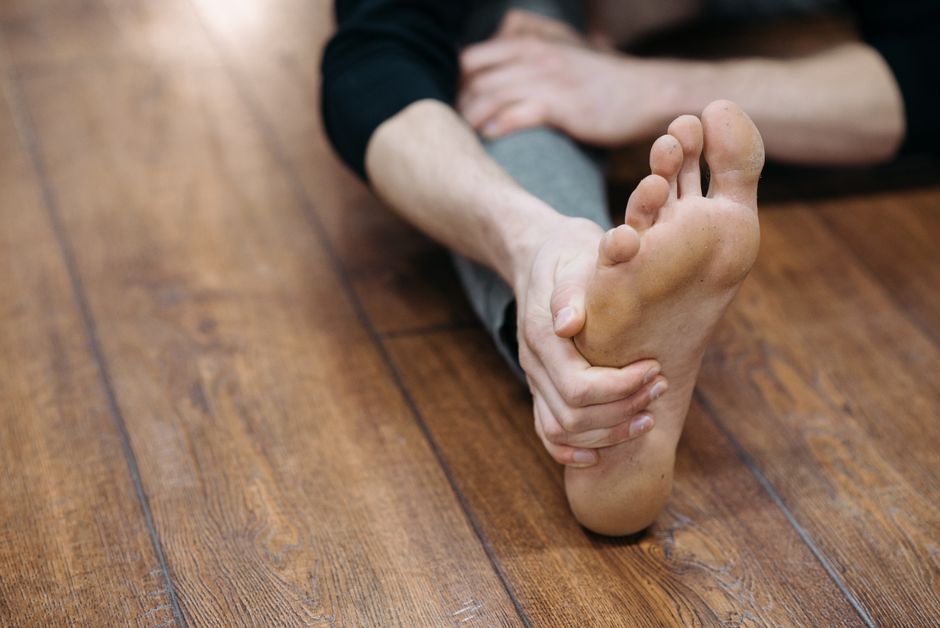
3. Calf and fascia stretch. Before you even stand up, loop a towel around the ball of your foot and pull your toes toward your shin. Hold 30 seconds. Do it again before that brutal first step out of bed. Stretching the calf and the fascia takes the edge off that morning pain.
4. Single-leg balance. Stand on one foot while you brush your teeth. A foot that cannot balance is a foot that cannot support you. This rebuilds the small stabilizers that quit on you years ago.
5. Real calf and lower-leg strength under load. Your lower leg runs everything below the knee. Strong calves pull stress off the fascia. This is where a real program earns its money, and it ties straight into the same strength training for women over 40 that protects your knees, hips, and back.
The mistakes that keep your heel angry
You can do every exercise above and still stay hurt if you keep doing the dumb stuff. So quit it.
Stop padding around barefoot on hardwood all day. Your fascia has no backup right now, so give it support until it is strong. Stop stretching cold and calling that a workout. Stretching helps the morning pain, but it does not build tissue. Stop going from zero to a 5k because a podcast told you walking is free medicine. And stop dropping fifty dollars on the miracle insole when the actual fix costs you ten quiet minutes a day.
One more. If your knees, hips, or lower back have been barking too, your feet are usually part of that story. The body is a chain. The heel is just where a weak chain finally screams loud enough for you to listen. Fixing the foot and building the strength that protects your knees is the same project.

How we train around it at the F.I.T.T. PIT
Here is what 13 years of coaching adults in Boston taught me. Almost nobody needs to stop training. They need to train the right thing the right way.
At the F.I.T.T. PIT we do not send you home to sit on the couch until your foot feels better. We load your calves and feet on purpose. We scale the jumping and the pounding while the tissue rebuilds. And we coach every rep so you get stronger without setting the pain on fire. Our second coach, Selene Williams, walked in as a member who felt broken and coached her way to a pro bodybuilding card. She will be the first to tell you that bodies do not need babying. They need a plan and someone who will hold you to it.
Your feet carried you this far. Return the favor and make them strong.
Frequently asked questions
How long does it take to fix plantar fasciitis?
Most people feel real change in six to twelve weeks of steady loading, not days. The heavy calf raise protocol showed its edge around three months. Do the work daily and stop resetting the clock every time you skip a week.
Should I stop working out with plantar fasciitis?
No. You scale it, you do not quit it. Cut the jumping and long runs for a bit, keep lifting, and add the foot and calf work. A coach makes that simple. Quitting makes it worse.
Are stretches enough to fix it?
No. Stretching calms the morning pain, which feels great, but it does not rebuild the tissue. Strengthening under load is what changes the outcome. Do both, but do not skip the heavy part.
Do expensive insoles fix plantar fasciitis?
They can take the edge off while you heal. They do not make your foot strong, and a weak foot stays a repeat customer. Use support as a crutch, not a cure.
Can I still lose weight while my foot heals?
Yes. You lift, you do low-impact conditioning, and you fix your nutrition. Less weight means less load on the fascia, so it helps both ways. Your foot is a reason to train smarter, not an excuse to stop.
Your first StrengthCamp class is on us
StrengthCamp is heavy work for bodies that have lived. First class is free. thefittpit.com


