
By Andre Thomas, NASM CPT | The F.I.T.T. PIT | July 6, 2026
Pelvic Floor Exercises for Women Over 40: Stop the Leaks
You crossed your legs before that last big sneeze. Be honest. Pelvic floor exercises for women over 40 are the thing nobody warned you about, and the thing a lot of you need most. A little leak when you jump, laugh, or run is common. Common is not the same as normal. And it is fixable.
What your pelvic floor actually does
Your pelvic floor is a hammock of muscle slung across the base of your torso. It holds up your bladder, uterus, and bowel. It decides when you pee and when you hold it. And it works with your deep core and your diaphragm every time you breathe, brace, or pick something up off the floor.
After 40, two things gang up on it. Estrogen falls through perimenopause and menopause, and that hormone drop thins and weakens the tissue that keeps everything tight. Then years of pregnancy, birth, holding your breath under heavy loads, and folding over a desk pile on top. The muscle either goes weak, or it locks up in a permanent clench. Both cause the same mess.
The signs your pelvic floor is weak (it's not just leaks)
Leaking when you sneeze, cough, jump, or run is the headline. That is called stress urinary incontinence, and it shows up in as many as one in three women. But it is not the only tell. Your body sends other signals long before you start buying the pads.
- Sudden urgency, like you need a bathroom right now
- Feeling like you never fully empty
- Low back or hip pain that will not quit
- A heavy, dragging feeling down low
- Pain during sex
- A core that will not fire no matter how many planks you grind out
That last one matters here. If your core exercises for women over 40 feel like they do nothing, a sleepy pelvic floor is often why.
Why Kegels alone won't fix it
Everybody hears the same tip. Do your Kegels. Squeeze like you are stopping your pee, hold, let go. Done with the right technique, Kegels help. But here is what nobody tells you. For a lot of women over 40 the floor is not weak. It is tight and cranked up, and squeezing a muscle that never lets go only makes it angrier. A tight floor leaks too. It also brings pain and urgency.
The floor has two jobs. Contract hard when you need it. And fully relax when you don't. Most women I meet have never trained the second job. So they Kegel all day and wonder why nothing changes. Learning to let go is half the work, and it is the half everyone skips.
Pelvic floor exercises for women over 40 that actually work
You train the floor as part of the system, not off in a corner by itself. Here is the short list we start people with.
- Diaphragmatic breathing. Lie on your back. Breathe wide into your ribs and belly. Feel the floor drop as you inhale and lift as you exhale. This is the base for everything else.
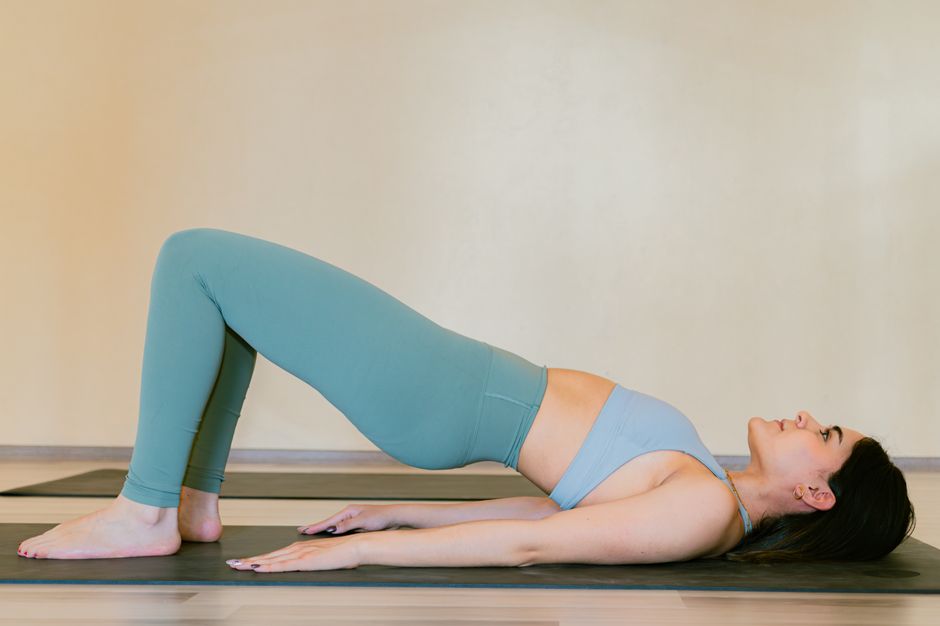
- Glute bridges. Drive through your heels and breathe out as your hips rise. This ties your glutes and floor together.
- Dead bugs. Lower the opposite arm and leg with your back flat and your breath steady. This teaches the floor to hold while your limbs move.
- Bird dogs. Same idea on hands and knees, reaching long instead of rushing.
- Deep squats. A full squat with real breathing loads and stretches the floor through its whole range.
A few rounds most days beats one heroic session a week. Two focused sets is plenty. You are not maxing out. You are teaching a pattern your body forgot, the same way you would build any other movement skill. Boring and steady is what works.

Breathing runs the whole thing
Your diaphragm and your pelvic floor are a matched set. They move together like a piston, up and down, on every breath. When you hold your breath and bear down under a heavy weight, you drive pressure straight down onto the floor. Do that for enough years and something gives.
Flip it around. Learn to breathe out on the hard part of a lift and the floor lifts with you. That one habit protects you more than a thousand random squeezes. It is also why holding your breath through a grinder of a set is a bad trade for any woman carrying a weak floor and a cranky lower back.
When you need a pelvic floor PT, not a coach
I coach strength. I am not your doctor, and I am not a pelvic floor physical therapist. If you have real pain, a heavy bulging feeling that could be prolapse, leaking that runs your day, or symptoms after birth that never went away, go see a pelvic floor PT. They can assess you internally and tell you if the floor is weak, tight, or both. That is not weakness. That is smart. Then we build strength around what they sort out.

How we train this at the F.I.T.T. PIT
Every woman who trains with us learns to brace and breathe before she touches a loaded bar. That is not a bonus round. That is the base. When you load your body with the floor doing its job, you get stronger and you stop leaking in the same block of work. Two problems, one fix.
This is where our semi-private coaching earns its keep. Two to four people with one coach means somebody is watching your breath and your bracing, not counting reps from across a packed room. It is the same reason our strength training for women over 40 starts with how you breathe, not how much you lift. Trained pelvic floor muscles cut down on leaks, and trained women walk taller doing it.
Frequently asked questions
Can pelvic floor exercises for women over 40 really stop bladder leaks?
For most stress leaks, yes. Pelvic floor muscle training beats doing nothing and is a first line fix. Give it 6 to 12 weeks of steady work before you judge it.
How long until I notice a difference?
Most women feel something inside a month or so and see bigger change by 12. Consistency wins here, not intensity. Miss a week and you are not back at zero, so don't quit over one bad stretch.
Are Kegels bad for me?
Not if your floor is truly weak. But if it is tight or you feel pain, random Kegels can make it worse. Learn the technique or get assessed first.
Can I lift heavy with a weak pelvic floor?
You can once you learn to breathe and brace. Holding your breath and bearing down is the problem, not the weight itself. Build the pattern light, then add load.
Does menopause make this worse?
It can. Lower estrogen thins the tissue and can bump up leaks and urgency. Training helps offset it.
Do I need special equipment?
No. Your body, a mat, and your own breath cover the basics. The gadgets you see online are optional, and most are a waste of money.
Train the floor that holds you up
Semi-private training is 2-4 athletes with one coach. Most popular is 2x/week at $740/month. Book a call with Andre. thefittpit.com


